
Photogrammar is an online digital visualization platform for the Farm Security Administration Office of War Information Photograph Collection. During the Great Depression the FWA hired photographers to roam the country taking photographs, hoping that these images could be used to garner support for the New Deal. As the project wore on, it eventually became a project to document the American experience. In total, over 170,000 photos were taken and collected in the Library of Congress. Photogrammer allows over 117,000 of these images to be easily accessible and searchable in a way that helps visualize the impact the Great Depression had across the nation by incorporating digital mapping. The site launched in 2012, was updated in 2014, and the current version of the site launched in 2021 with added historical context and a new interface. The site is housed by the University of Richmond and maintained by its Digital Scholarship Lab and Distant Viewing Lab with a team led by director Lauren Tilton.
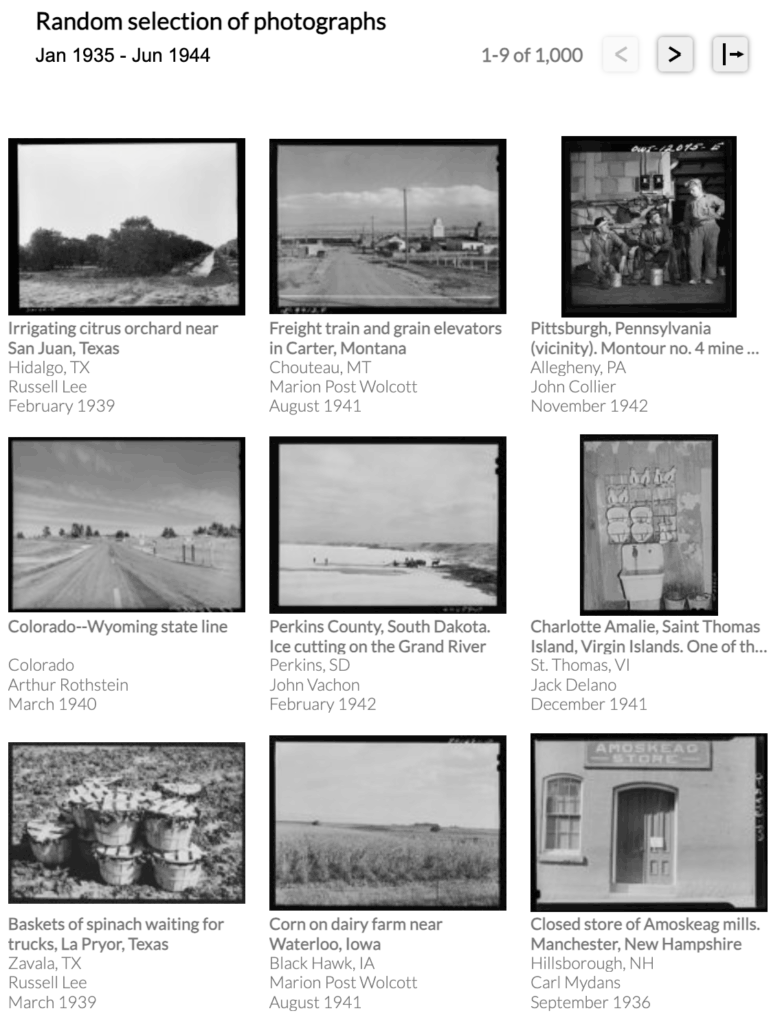
The landing page’s photo archive
The landing page interface is clean and simple. The photo archive is on the left of the screen and displays photos in a 3×3 grid. The landing page features a selection of 1,000 random. The website also allows the users to adjust the display so that the photo archive display can take up more room than the map. The right side of the screen is taken up by the map and the timeline below that. Clicking on a state or county shows reveals the photographs taken within it in the photo archive on the left, as well as which photographers were active in the state and when. Below the map, there is a timeline with the year 1935 – 1944 along the x axis and a list of photographers forming the y axis. This timeline allows users to adjust the map so it can show where photographs were taken in certain years. Clicking on a photographer’s name changes the map the show where the photographer took pictures. Alternatively, users can search by city rather than county, with green circles illustrating photo density, though this is less reliable than the county map. Users can also a search the collection through a theme page.
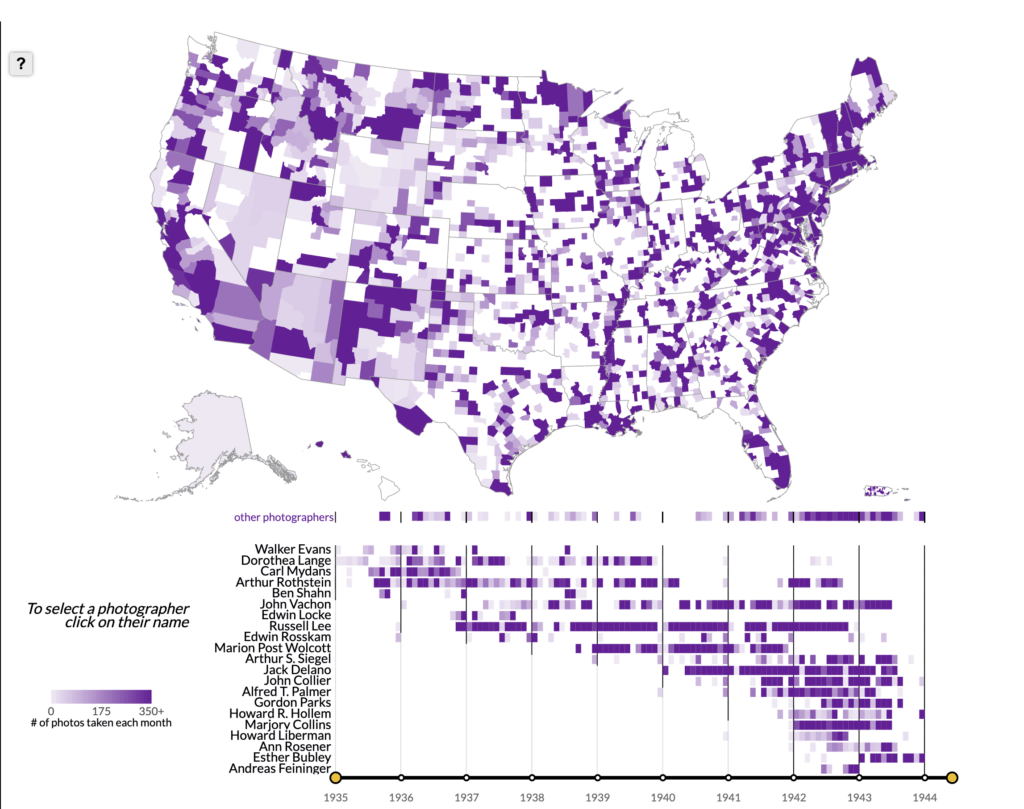
The Photogrammar map and timeline
Once an image is found, clicking on the image takes users to a page that displays a larger photo along with the relevant metadata and a link to its Library of Congress entry. Below this, the site suggests further similar images, thus allowing another avenue for discovery and takes advantage of more modern digital trends.
Considering its scope, the project provides only a little historical context about the project. A short introduction page explains the origins and purpose of the FWA-OWI photography project. Instead, the designers of the website allows the sheer size and scope of the collection and the subjects of the photographs to speak for itself. Additionally, there are short biographies of many of the photographers associated with the project. I was delighted to find out that some of these biographies come with a recorded oral history of their time working as a photographer, giving more depth and dimension to this collection.
One of the strengths of the platform is the ability for users to filter their searches and having those filters reflected on the map. A user could easily filter for photos of migratory farm workers taken by Dorothea Lange in California and the photo archive would display the relevant images and where they were taken on the map, visualizing where Lange travelled and found her photo subjects. This type of visualization allows users to see at a glance when and where photographs were taken without having to delve into Library of Congress catalog metadata. The map illustrates where photographers were active and when, and it allows users to trace their journey across the country with the combination of the map and timeline.
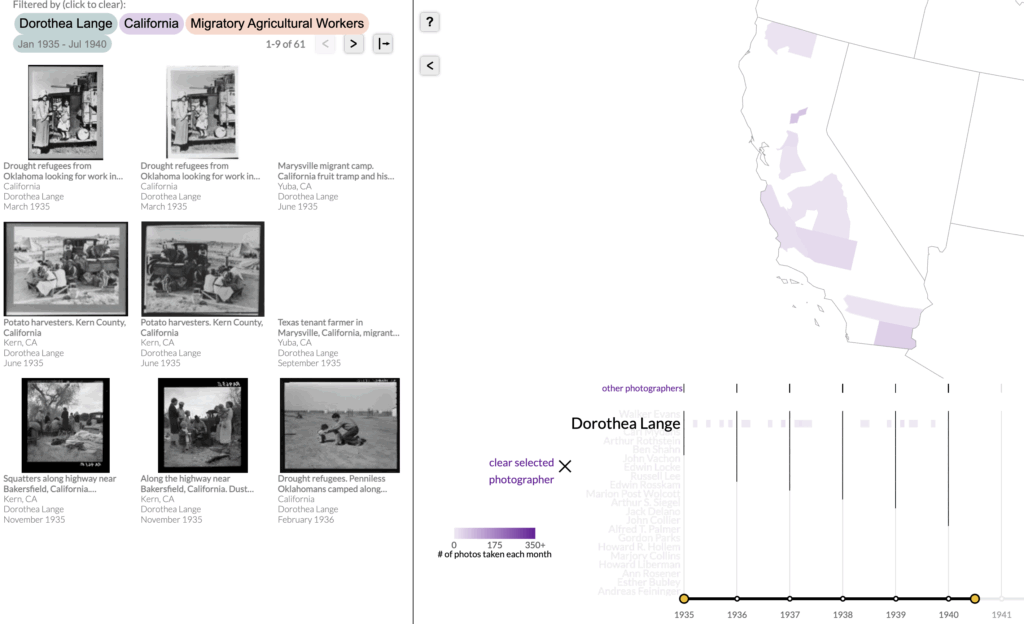
An example of a heavily filtered search
The site is heavily reliant on the Library of Congress system as that is where the physical collection is housed. Every image included in the collection has a link to take the user to its Library of Congress page. One thing to note is that the metadata associated with the collection to aid in searching is based on the original 1942 classification system used by the FWA-OWI. These terms may not be the most intuitive and are some are far from natural language most people may use to search. There is also an obvious typo for a large category of images, the searchable phrase is “premanent homes” rather than permanent homes. These types of quibbles with the tagging system can present problems if a user doesn’t know the exact term of what they want to look for.
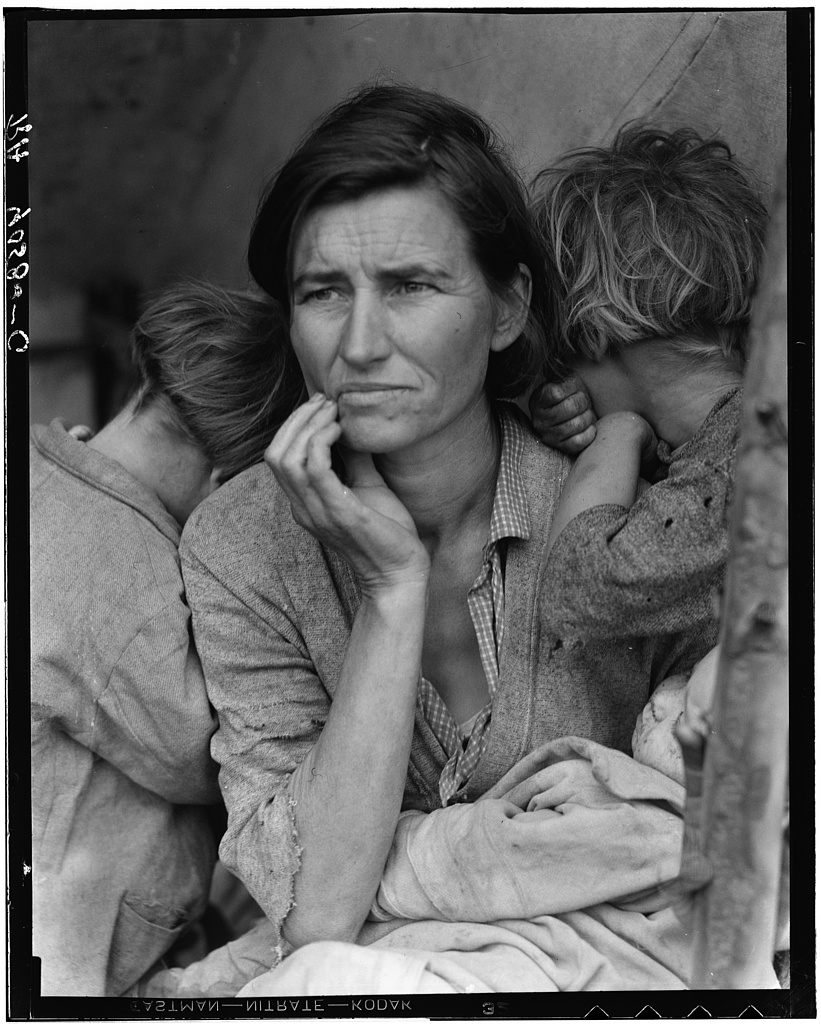
This iconic photo is not called by its common name ‘Migrant Mother’ in the database, but ‘Desititute pea pickers in California. Mother of seven children. Age thirty-two. Nipomo California.’ Searching for this photo under ‘migrant mother’ yields no results, illustrating how finding specific images can be difficult without knowing what to look for
The search function for captions suffers from similar problems. Other quibbles include how users must navigate between the map and theme page before any map visualization was seen. The timeline works well except for a glitch when filtering between January and April 1935. Additionally, there are some limits to filtering, as only one theme can be searched at a time with no way to search multiple themes at once. This can be frustrating, especially as photographs can be separated into different themes even though they may have similar subject matter.
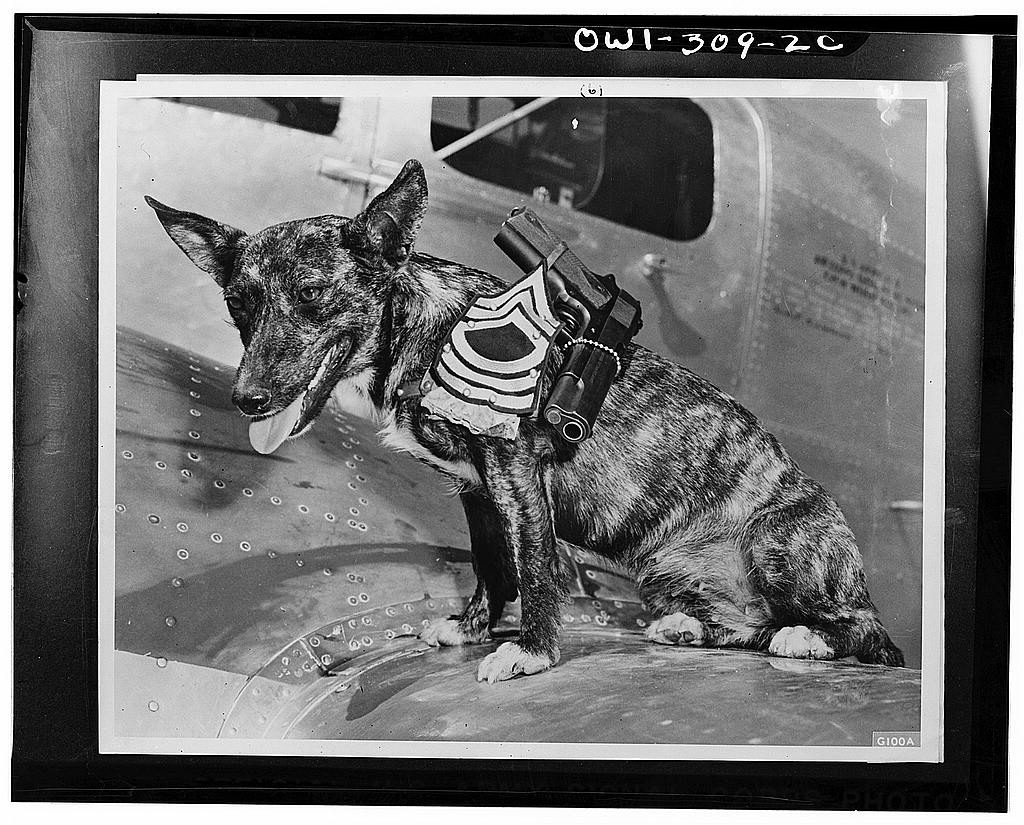
This image was filed under War/Induction, General Training/Mascots rather than Alphabetical Section/General/Dogs, highlighting how the 1942 tagging system can lead to confusion and make certain images harder to find.
There is no clearly defined audience for this project, rather it is for anyone looking to understand more about Great Depression era America through primary source photos. I can see Photogrammar being useful for historians, but also as a valuable tool for classrooms. The organization of the site allows for beginners to find images right away through the landing page or the map while more advanced users can construct filtered visualizations and searches. One purpose of the project is to make the FWA-OWI photo collection more accessible, and it excels in this goal.
Overall, Photogrammar is an excellent way for anyone to explore the enormous archive of the FWA-OWI photographs in an engaging and easily accessible way. The site allows for multiple points of entry into the photo collection with its main strength being the map to visualize the photographs geospatially. While there are some problems that stem from the dated tagging system used and other filtering features, the site is a marvel in the way it allows users to quickly sort and find photos with the combination of the map and filters. Photogrammar works best as a discovery tool, allowing users to easily connect with the past and helping them visually understand the scope and scale of the FWA-OWI photo project and the impact the Great Depression had on the nation.
Photogrammar. https://photogrammar.org/maps Created by Lauren Tilton, Taylor Arnold, Nathanial Ayers, Justin Madron, Rob Nelson, and Laura Wexler and maintained by Univeristy of Richmond’s Digital Scholarship Lab and Distant Viewing Lab. https://photogrammar.org/about. Reviewed Septmeber 20 -October 2, 2025.
Leave a Reply