Tuesday marked the first day of my internship at the Mount Prospect Historical Society. My first hour was dedicated to getting introduced to my fellow coworkers by Emily, the director of MPHS and my supervisor for this internship. I also got a brief tour of the historical society, which is in the Dietrich Fredericks House, a historical house built by one of the first families to live in Mount Prospect. After the tour, I was shown my workspace, a cozy desk tucked under the staircase in the basement of the house.
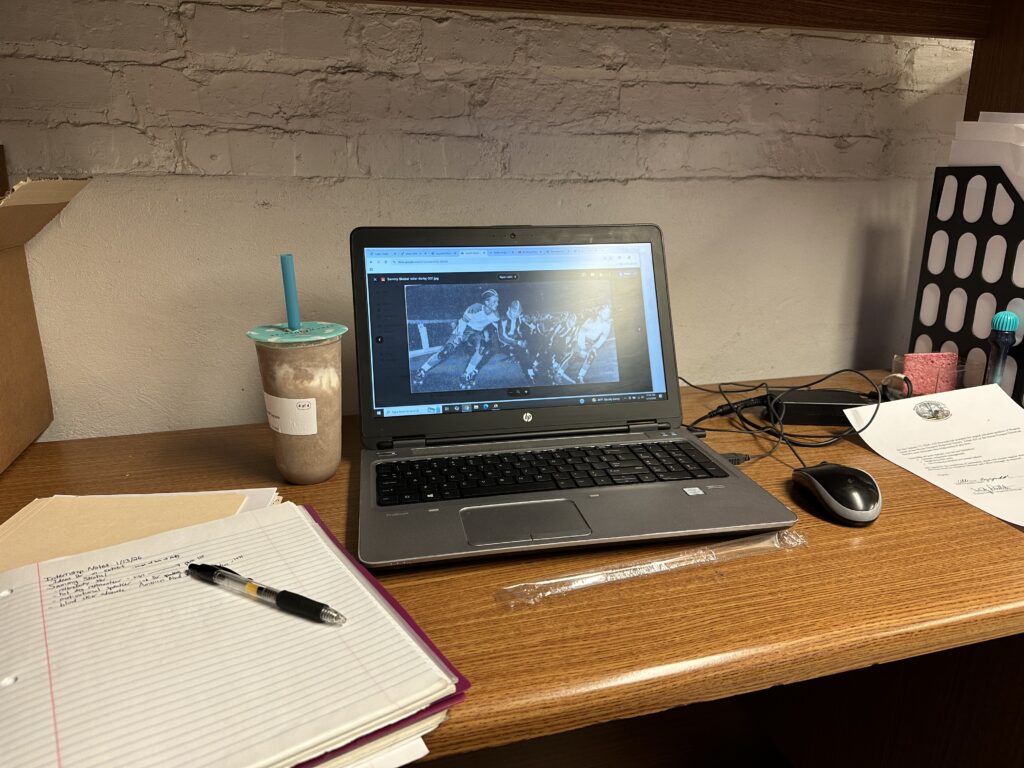
The rest of the day was dedicated to familiarizing myself with the collection and thinking about what topic I may want to explore more for an exhibit in the museum. I spent a good portion of the day familiarizing myself with the collection on PastPerfect, the historical society’s collection management software. It has a dated UI and was very slow, so it was a little hard to navigate, but I was able to get a feel of what is in the MPHS collection. I was also able to to access the MPHS Google Drive, where there were many digitized papers and photographs.
Based on Emily’s advice and what was available in the collection, I decided to do research on Sammy Skobel, a local Mount Prospect hero. Sammy was famous in Mount Prospect for his hot dog restaurant but before that, he had risen to fame as a championship roller derby skater. Skating from 1945 to 1965, Sammy was one of the most revered skaters in the league winning MVP 3 times. Oh, and he was also blind, with only 10% of his vision. He also created a foundation for blind skiers, providing funding for guided skiing trips and introducing blind people to guided skiing. There’s a lot of materials related to Sammy in the collection including his skates and trophies. I spent most of the day looking through his file and the paper materials associated with him, mainly newspaper articles and photographs.
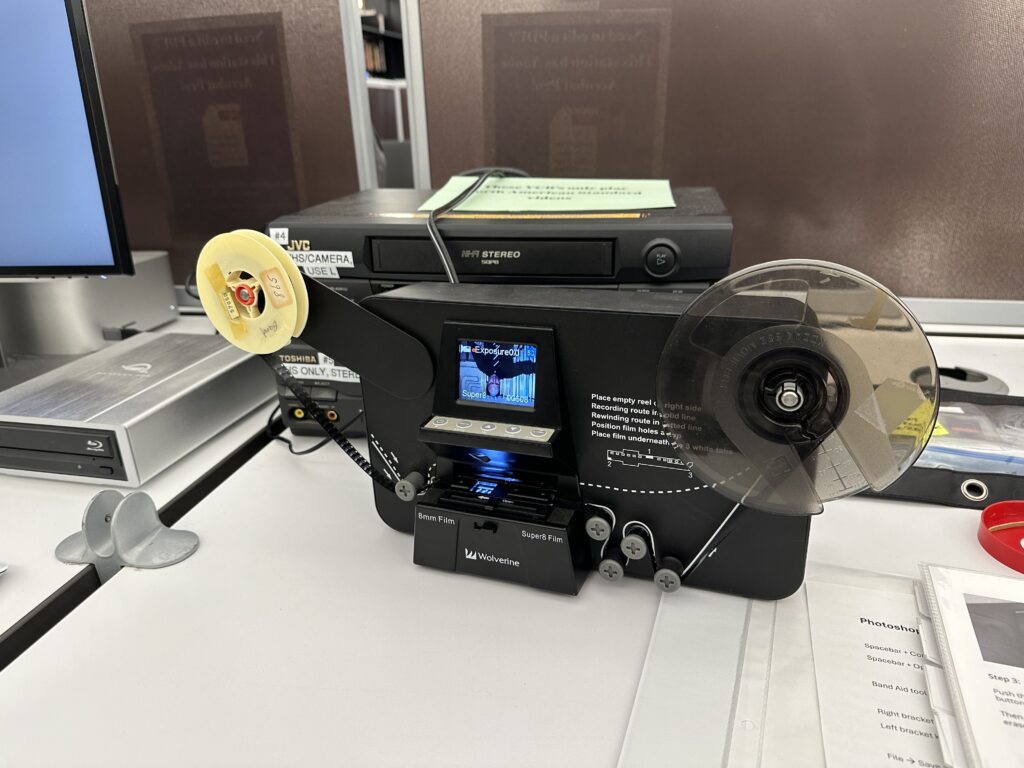
On Wednesday, I didn’t report to the historical society but instead continued my internship at the Mount Prospect Public Library. I work there in the circulation department, so after I clocked out at 4, I went upstairs to the computer studio where they have a film digitizer. Emily had given me a few short 8mm tapes to start with. After the staff got the device set up, I was on my own. I was able to figure out how to thread the film through the machine and was able to record the entire film strip. Even though the final product was two minutes long, it took about 25 minutes to digitize! The film was footage from an elementary school band class, circa 1968. While the final product was crisp and clear, it was also backwards, reversed and flipped upside down, the last person to use the film had put it back on the reel wrong. Even so, I was proud of my first digitization effort.
On Thursday I was back at the historical society. Since Emily knew I was looking into Sammy Skobel, she pulled his autobiography from the collection for me to look at. It proved a valuable resource. Using the book and the newspaper articles, I was able to begin to build a timeline as well as pulling key facts and stories from Sammy’s life. It also got me thinking of what materials would best work in an exhibit. I was also able to do some background research in the sport of roller derby since it’s so important to Sammy’s life and career. Roller derby was started in Chicago and by the time Sammy joined in the 40s was an organized sport. The sport was surprisingly equal for its time with men and women competing on the same team on equal footing. The women would usually skate in the first round and then the men would tag in. The men and women would skate for four rounds each, with all rounds counting towards the final score. Roller derby was a rough sport, with crashes and physical contact the norm. I was able to find a few videos of Sammy skating in roller derby circa 1952. At this time he was part of the New York City Chiefs and was number 23. ]These videos really highlight the high contact nature of the sport. It gives me an extra appreciation for Sammy knowing that he was able to compete while only able to make out vague shapes and light.
On Friday, I was back at the library digitizing. I rewound the band class film and was able to reorient the film to be right side up and actually start from the beginning. It was a perfect take. I also managed to get another film digitized, this one was footage from a local Halloween parade, also circa 1968. Overall, a productive first week!
Leave a Reply